
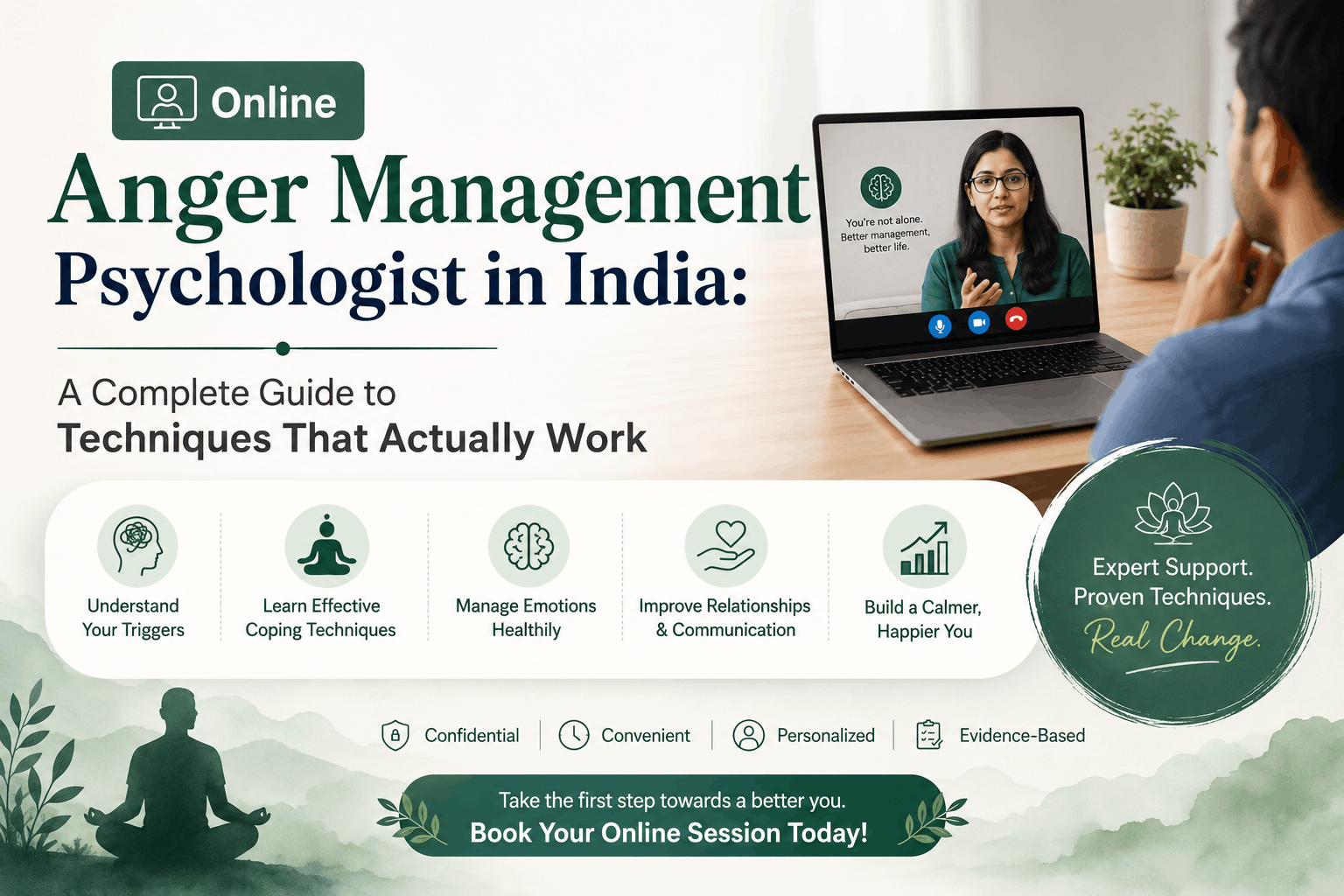
Online Anger Management Psychologist in India: A Complete Guide to Techniques That Actually Work
Anger is one of the most misunderstood emotions in mental health. It isn't a character flaw, and it isn't something you simply need more "willpower" to control. Anger is a signal — usually one that something feels unfair, unsafe, disrespected, or out of control. The problem isn't the emotion itself; it's what happens when anger goes unmanaged for years: strained marriages, damaged careers, health problems, and a nagging sense of guilt after every outburst.
If you've searched for an online anger management psychologist, you're likely already noticing the cost anger is taking on your life — maybe it's a partner who's grown distant, a child who flinches at your tone, or a boss who's mentioned your temper in a review you'd rather forget. This guide walks through what anger management therapy actually involves, the techniques a trained psychologist uses, and how to know if online counselling is the right fit for you.
Table of Contents
- Why Anger Builds Up in the First Place
- Signs Your Anger Needs Professional Support
- Why Choose an Online Anger Management Psychologist
- Evidence-Based Techniques Used in Anger Management Therapy
- What a Typical Online Anger Management Session Looks Like
- Anger Management vs. Suppression: Why the Difference Matters
- How Long Does Anger Management Therapy Take?
- Choosing the Right Psychologist for Anger Management
- FAQs
Why Anger Builds Up in the First Place
Anger rarely appears out of nowhere. Underneath most anger sits a more vulnerable emotion — fear, shame, grief, exhaustion, or feeling unheard. Common root causes include:
- Chronic stress at work or home that leaves little emotional bandwidth
- Unresolved trauma or childhood conditioning, especially in households where anger was the only emotion allowed
- Unmet expectations, both of others and of oneself
- Poor communication patterns that turn small disagreements into major conflicts
- Underlying conditions like anxiety, depression, or burnout, which lower the threshold for irritability
A psychologist's first job isn't to tell you to "calm down" — it's to help you understand which of these is actually driving your reactions, because the treatment approach differs depending on the root cause.
Signs Your Anger Needs Professional Support
Not every flash of frustration needs therapy. Consider reaching out to an anger management psychologist if you notice:
- Anger that feels disproportionate to the situation that triggered it
- Physical symptoms — a racing heart, clenched jaw, or shaking — several times a week
- Regret or shame after arguments, followed by the same pattern repeating
- Loved ones expressing that they feel afraid, hurt, or "walking on eggshells" around you
- Anger spilling into unrelated situations (snapping at family after a stressful workday)
- Using anger to avoid dealing with sadness, anxiety, or vulnerability
Why Choose an Online Anger Management Psychologist
Online therapy has removed one of the biggest barriers to getting help: the discomfort of walking into a clinic and admitting, out loud, "I have a temper I can't control." For many people, that admission is easier to make from the privacy of their own home.
Practical advantages of online anger management counselling:
- Privacy — no waiting rooms, no risk of running into someone you know
- Consistency — sessions can happen even while travelling, working from another city, or managing a hectic schedule, which matters because consistency is the single biggest predictor of therapy success
- PAN-India access — you're not limited to psychologists in your city; you can work with a specialist who fits your specific needs regardless of location
- Lower activation energy — for someone already overwhelmed, logging into a video call is a smaller step than commuting to an appointment
Online sessions are not a "lighter" version of therapy. A qualified, RCI-registered clinical psychologist uses the same structured, evidence-based frameworks online as they would in person.
Evidence-Based Techniques Used in Anger Management Therapy
1. Trigger Mapping
Before anger can be managed, it has to be understood. Your psychologist will help you track situations, thoughts, and body sensations that precede anger episodes — often using a simple diary between sessions. Over time, this reveals patterns you likely couldn't see on your own.
2. Cognitive Restructuring (CBT)
Anger is fuelled by thinking patterns like catastrophizing ("this ruins everything"), mind-reading ("they did this on purpose"), or rigid rules ("things must go my way"). Cognitive Behavioral Therapy helps you catch these thoughts in the moment and replace them with more balanced, accurate interpretations — which directly reduces the intensity of the emotional reaction.
3. Physiological Regulation
Anger has a strong physical component — adrenaline, elevated heart rate, muscle tension. Techniques like paced breathing, progressive muscle relaxation, and grounding exercises work directly on the nervous system, creating a pause between the trigger and the reaction.
4. The "Time-Out" Protocol, Done Correctly
Many people already try to "walk away" when angry, but without structure this often looks like stonewalling, which damages relationships further. A psychologist teaches a proper time-out protocol: naming the need for space, committing to a return time, and using the break to actually regulate rather than ruminate.
5. Assertive Communication Training
A large share of chronic anger comes from a communication gap — not expressing needs early enough, then exploding once frustration accumulates. Assertiveness training teaches you to state needs, boundaries, and disagreements clearly and early, without aggression or passive resentment.
6. Addressing the Root Emotion
Because anger is often a secondary emotion, therapy frequently moves into what's underneath it — grief, anxiety, feeling powerless, or old attachment wounds. This is where longer-term individual therapy, rather than a quick "anger management course," tends to produce lasting change.
7. Relapse Prevention Planning
Toward the end of a structured program, your psychologist helps you build a personalised plan for high-risk situations — the specific people, environments, or stressors most likely to trigger a setback — so progress holds up outside the therapy room.
What a Typical Online Anger Management Session Looks Like
- Session 1–2: Assessment — understanding your history, triggers, and how anger is currently affecting your relationships and daily life
- Session 3–6: Skill-building — introducing cognitive and physiological regulation tools, practising them with real examples from your week
- Session 7 onward: Deeper work on root causes, communication pattern changes, and relapse prevention
Sessions are typically 45–60 minutes over video call, with practical exercises to try between sessions — anger management is a skills-based process, not something resolved through talking alone.
Anger Management vs. Suppression: Why the Difference Matters
A common misconception is that "managing" anger means not feeling it or never expressing it. That's suppression, not regulation — and suppression tends to backfire, showing up later as resentment, passive-aggression, or physical health issues like high blood pressure. Genuine anger management means the emotion is still felt and acknowledged, but expressed in a way that doesn't damage relationships or wellbeing.
How Long Does Anger Management Therapy Take?
Most people notice initial changes — a longer pause before reacting, more awareness of triggers — within 4 to 6 sessions. Deeper, lasting change in communication patterns and root-cause work typically takes 3 to 6 months of consistent sessions, though this varies based on individual history and how long the pattern has been in place.
Choosing the Right Psychologist for Anger Management
When evaluating an online anger management psychologist, look for:
- RCI registration or equivalent recognised clinical credentials
- Experience specifically with anger, stress, and conflict-related cases, not just general counselling
- A structured, evidence-based approach (CBT, transactional analysis, mindfulness-based techniques) rather than generic advice
- Clear confidentiality practices for online sessions
- Flexibility to work around your schedule, given PAN-India availability
Ready to Take the First Step?
Anger that's gone unmanaged for years doesn't need judgment — it needs the right support. At Compassionate Minds, our RCI-registered psychologists use structured, evidence-based anger management therapy to help you understand your triggers, regulate your reactions, and rebuild the relationships anger may have strained. Sessions are available online across India and in person in Gurugram.
FAQs
Is online anger management therapy as effective as in-person sessions? Yes. Research on telehealth consistently shows comparable outcomes to in-person therapy for anger, anxiety, and stress-related concerns, provided sessions are conducted by a qualified professional using structured, evidence-based methods.
How many sessions will I need for anger management? Most people begin noticing changes within 4–6 sessions, with deeper, lasting change typically developing over 3–6 months of consistent work, depending on individual circumstances.
Can anger management help if my anger is affecting my marriage or family? Yes. Anger management therapy often includes communication skills training specifically aimed at repairing and protecting close relationships, and can be paired with couples or family counselling when needed.
Is it normal to feel ashamed about needing anger management help? Very common — but shame usually keeps the cycle going rather than breaking it. Speaking with a psychologist in a private, judgment-free setting is often the first real step toward change.
Do you offer anger management sessions in Hindi or regional languages? Many of our psychologists offer sessions in Hindi and English; ask during your free consultation to be matched with the right expert for your language preference.
 Mobile No. : +91-9151006808