
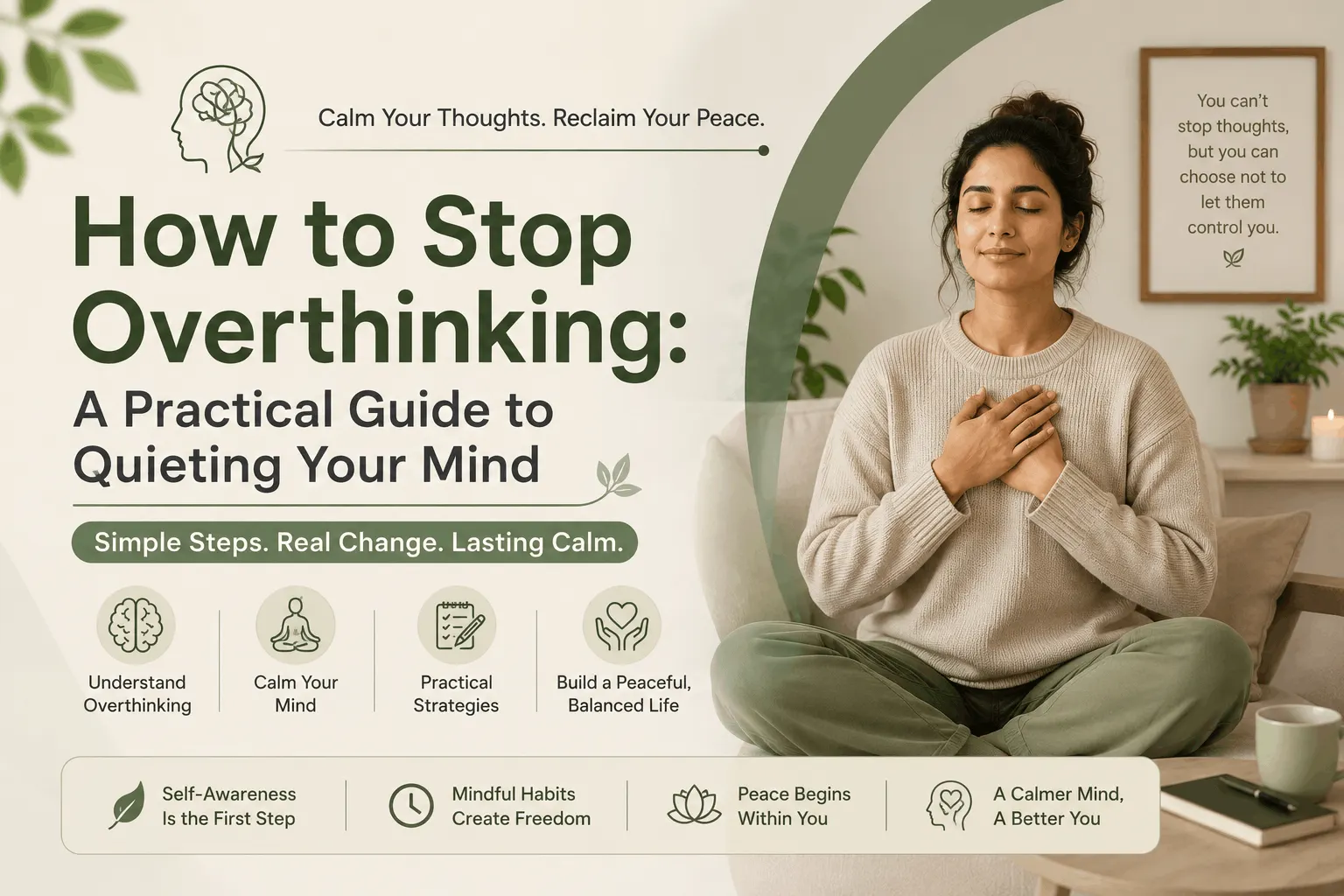
How to Stop Overthinking: A Practical Guide to Quieting Your Mind
It's 1 a.m. and you're replaying a conversation from three days ago, wondering if that one
sentence sounded rude. Or you're staring at your ceiling, running through every possible way
tomorrow's meeting could go wrong. If this sounds familiar, you're not alone — overthinking is one of the most common struggles people bring into therapy today, and it rarely announces itself as a "disorder." It just feels like your brain won't switch off.
Overthinking isn't a sign of weakness or a personality flaw. It's a pattern your mind has learned, usually as a misguided attempt to feel safe or in control. The good news is that because it's a learned pattern, it can be unlearned. This guide breaks down why overthinking happens and
gives you practical, therapist-backed strategies to quiet the noise.
What Overthinking Actually Is
Overthinking shows up in two main forms: rumination, where you replay the past ("Why did I say that?"), and worry, where you spiral about the future ("What if this goes wrong?"). Both feel like problem-solving, but they rarely lead anywhere productive. Instead, they keep your nervous system in a low-grade state of alert, which is exhausting even when you haven't done anything physically demanding.
Psychologically, overthinking often develops as a coping mechanism. If you grew up needing to anticipate other people's moods, or you've been burned by situations you didn't see coming,
your mind learns that constant analysis equals safety. The problem is that this strategy stops being useful and starts running on its own, long after the original threat is gone.
Why Your Brain Loves to Loop
Three things keep the overthinking cycle alive. First, uncertainty is uncomfortable, and your brain treats "thinking about it more" as a way to resolve that discomfort, even when more thinking produces no new information. Second, overthinking gives an illusion of control — it feels like you're doing something, even though you're not actually acting. Third, many people
overthink because they were never taught how to sit with difficult emotions, so the mind keeps busy analyzing instead of simply feeling and processing.
Understanding this is important because it shifts the goal. You're not trying to "think your way out" of overthinking — that's the same trap in a different outfit. You're trying to interrupt the pattern itself.
7 Ways to Stop Overthinking
- Name It When It's Happening
The fastest way to loosen overthinking's grip is to notice it in real time. When you catch yourself spiraling, simply say to yourself, "I'm overthinking right now." This small act of labeling
activates a different part of the brain than the one driving the loop, and it creates a tiny gap between you and the thought — enough space to choose a different response.
- Set a "Worry Window"
Instead of trying to never think about a worry (which usually backfires), give it a designated
time — say, 15 minutes in the evening. When intrusive thoughts show up outside that window, jot them down and tell yourself, "I'll think about this at 7 p.m." Most of the time, by the time the window arrives, the thought has lost much of its urgency.
- Ask "Is This Useful or Just Repetitive?"
Productive thinking moves toward a decision or action. Overthinking just loops. When you catch your mind cycling, ask: Is this thought leading me anywhere new, or is it the same worry on
repeat? If it's repetitive, that's your cue to consciously redirect your attention rather than follow it further.
- Use Your Body to Interrupt Your Mind
Overthinking lives almost entirely in your head, which is exactly why physical activity is so
effective at breaking it. A brisk walk, stretching, or even five minutes of deep breathing shifts blood flow and attention away from rumination. You don't need an intense workout — the goal is simply to get out of your head and back into your body.
- Challenge the Catastrophic Story
Overthinking often inflates worst-case scenarios into near-certainties. Try asking yourself three questions: What's the evidence for this thought? What would I tell a friend who had this exact worry? And what's the most realistic outcome, not the worst one? This isn't about forcing positivity — it's about giving your mind a more accurate, balanced picture to work with.
- Limit Decision Fatigue
Overthinking thrives when your mental energy is already depleted. If you're constantly overanalyzing small decisions — what to wear, what to reply, what to order — you have less capacity left to manage bigger worries. Simplify where you can: set routines, default choices, or time limits on minor decisions so your mind has more room to handle what actually matters.
- Talk to Someone Who Can Help You See the Pattern
Sometimes overthinking is tangled up with deeper anxiety, past experiences, or perfectionism, and self-help strategies alone aren't enough to shift it. A therapist can help you understand the root of your specific pattern and work through it with structured approaches like Cognitive
Behavioral Therapy (CBT), which is particularly effective at identifying and reshaping the thought loops that fuel overthinking.
When Overthinking Becomes Something More
Occasional overthinking is part of being human. But if it's affecting your sleep, your relationships, your work, or your ability to make even simple decisions, it may be a sign of an underlying anxiety pattern that deserves professional attention. There's no shame in this — it simply means your mind has been working overtime for too long, and it's time to give it real support rather than more willpower.
Moving From Surviving to Feeling Steady
Overthinking convinces you that the next round of analysis will finally bring relief. It rarely does. Relief comes instead from interrupting the pattern, building awareness of your triggers, and — when needed — working with someone who can help you untangle what's really driving
the loop. You don't have to outthink your way to peace of mind; you have to learn a different way of relating to your thoughts altogether.
If overthinking has been quietly running your days and nights, you don't have to figure it out alone. A judgment-free conversation with a qualified psychologist can help you understand your specific pattern and build a practical plan to manage it.
Ready to quiet the noise in your mind? Book a free consultation with our team today and take the first step toward a calmer, clearer headspace.
Frequently Asked Questions (FAQs)
Q1. Is overthinking anxiety?
Answer: While overthinking itself is a mental habit rather than a formal medical diagnosis, it is closely linked to anxiety disorders. Chronic overthinking—such as constantly ruminating over past events or excessively worrying about future scenarios—is one of the core symptoms of Generalized Anxiety Disorder (GAD) and social anxiety.
Q2. How to stop overthinking and worrying?
Answer: To break the overthinking cycle, try these proven techniques:
- Practice Mindfulness & Grounding: Use techniques like the 5-4-3-2-1 sensory method to bring your mind back to the present moment.
- Set a "Worry Window": Schedule a dedicated 15-minute slot during the day to process worries, then put them away.
- Challenge Your Thoughts: Ask yourself if your thoughts are based on facts or assumptions.
- Focus on Actionable Steps: Shift your focus from looping on the problem to finding small, manageable solutions.
- Seek Professional Coaching or Therapy: Guided counseling can provide tailored coping strategies.
Q3. Why do I worry and overthink everything?
Answer: Overthinking usually stems from a need for control, fear of failure, perfectionism, past emotional stress, or high daily tension. Your brain enters a hyper-vigilant "threat-detection mode" to protect you from unexpected outcomes, which unintentionally creates an exhausting loop of worry.
Q4. What are the dangers of overthinking?
Answer: Prolonged overthinking can severely impact your mental and physical health. Key dangers include:
- Chronic Mental Exhaustion & Fatigue
- Sleep Disturbances and Insomnia
- Decision Paralysis (inability to make timely choices)
- Elevated Stress Hormones (Cortisol) leading to physical health issues
- Increased Risk of Clinical Anxiety and Depression
Q5. What drink calms anxiety?
Answer: Soothing, natural beverages that help calm the nervous system include:
- Chamomile Tea: Known for its gentle sedative properties.
- Green Tea / Matcha: Contains L-theanine, an amino acid that promotes relaxation without drowsiness.
- Peppermint Tea: Helps relieve physical tension and muscle stress.
- Warm Turmeric Milk: Helps reduce systemic inflammation and promotes relaxation.
 Mobile No. : +91-9151006808