
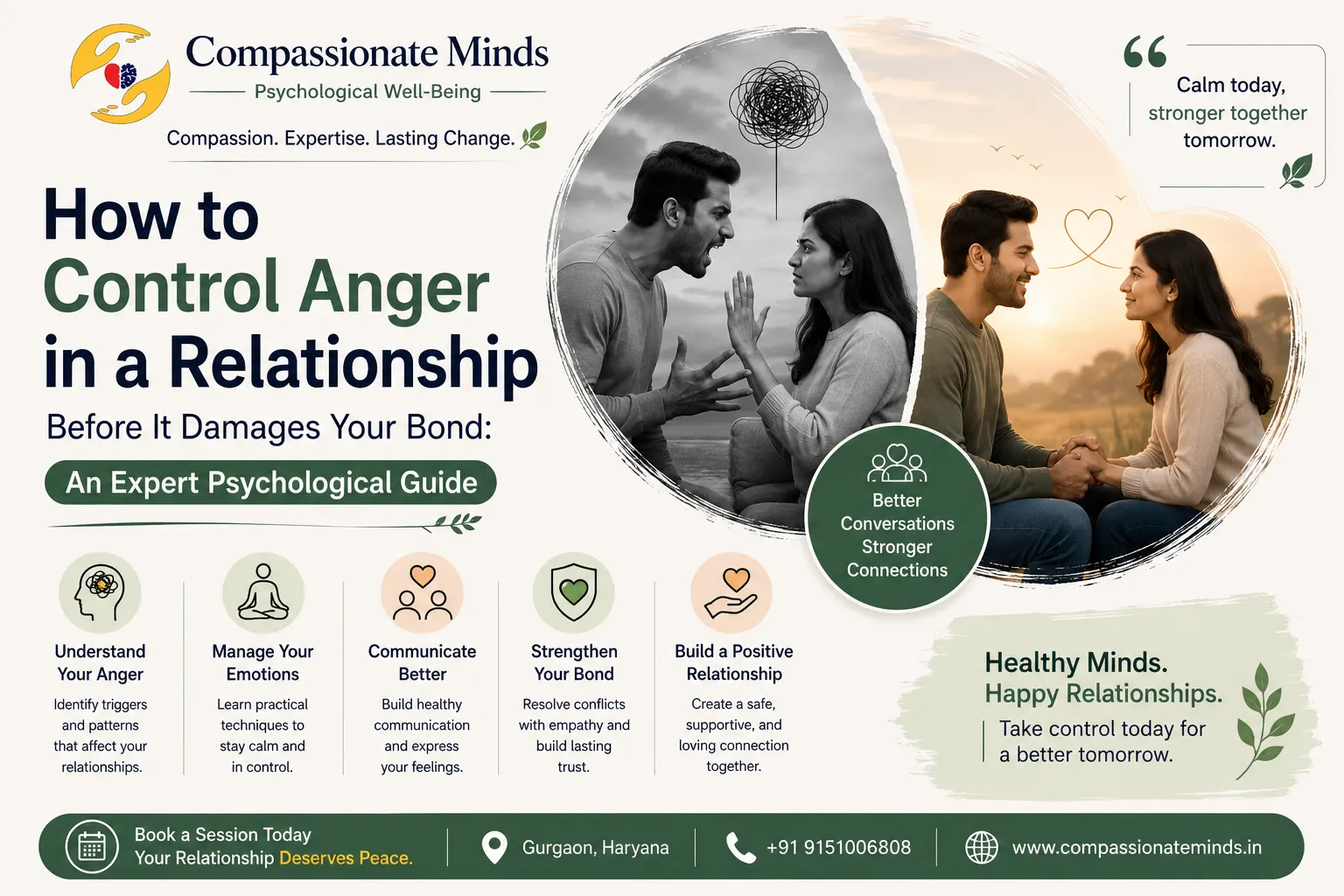
How to Control Anger in a Relationship Before It Damages Your Bond: An Expert Psychological Guide
Anger in a relationship rarely arrives with a sudden, catastrophic explosion on day one. More often, it leaks in quietly a sharp, sarcastic comment during breakfast, a heavy door slammed in frustration, an exasperated sigh during a conversation, or a cold, punishing silence that stretches over days.
Over months and years, these small, unaddressed moments of frustration compound. Partners begin walking on eggshells around each other, hyper-vigilant and anxious, waiting for the next argument to erupt. What once felt like a safe haven slowly turns into a battleground of resentment and defense mechanisms.
If you frequently find yourself exploding at the person you love most, or if you feel trapped in a cycle of constant arguing, it is crucial to know this: Anger is not a personality trait; it is a behavioral reaction. With psychological insight, self-awareness, and clinical tools, you can break this destructive loop and rebuild a grounded, loving connection.
The Psychology of Anger: Understanding the Iceberg Effect
To effectively manage anger, we must first understand what it actually is. In clinical psychology and Cognitive Behavioral Therapy (CBT), anger is primarily understood as a secondary emotion.
Think of anger as an Iceberg:
- The Visible Tip (Secondary Emotion): This is the outward expression that everyone sees shouting, slamming doors, stonewalling, or hurling insults.
- The Hidden Base (Primary Emotions): Deep beneath the surface lie vulnerable feelings such as fear of abandonment, feeling unappreciated, emotional betrayal, deep exhaustion, or feeling completely unheard.
Why "You Statements" Destroy Communication
When primary emotions are masked by secondary anger, communication breaks down instantly:
- What you feel inside: "I felt frightened and lonely when you came home late without calling."
- What comes out of your mouth: "You are selfish and you never care about this family!"
The first statement invites empathy and reassurance; the second statement triggers immediate defensiveness and counter-attack. The primary cause of relationship breakdown is rarely the anger itself, but the inability to express the vulnerable emotion beneath it.
Early Warning Signs: How Uncontrolled Anger Erodes Emotional Bonds
Anger manifests in subtle ways long before it completely destroys intimacy. Identifying where you or your partner fall on this spectrum is the key to early intervention.
1. Sharp Tones and Escalated Volume
Raising your voice or adopting a condescending, sharp tone forces your partner’s nervous system into a "fight-or-flight" response. Over time, this creates psychological unsafety, causing one partner to mentally check out of the relationship.
2. Emotional Withdrawal (Stonewalling)
Stonewalling occurs when one partner completely shuts down, refuses to respond, or leaves the room mid-conversation without warning. While often used as a defense mechanism to self-soothe, psychology research shows that long-term silent treatment feels like physical pain to the receiving partner and erodes trust.
3. The Blame Game and Character Attacks
When arguments shift from addressing a specific behavior to attacking a partner's character ("You are lazy," "You are irresponsible"), resentment builds rapidly. The goal shifts from solving the problem to winning the argument.
4. Physiological Hyperarousal
Your body registers emotional anger physically before your brain rationalizes it. Common biological signs include:
- A rapidly spiking heart rate (above 100 BPM)
- Muscle tightness, clenched jaw, or tight chest
- Shallow, rapid breathing
- Tunnel vision and heat in the face
6 Evidence-Based Steps to Control Anger in the Moment
When emotional distress peaks, the brain’s amygdala (the emotional alarm system) hijacks the prefrontal cortex (the rational, problem-solving center). Here are six psychological strategies to regain emotional regulation in real time:
|
Step |
Action Strategy |
Core Benefit |
|
1. Detect Physical Triggers |
Spot racing pulse or clenched jaws immediately |
Gives you a 5-second window to stop emotional reactions |
|
2. Use "I" Statements |
Focus on your feelings rather than accusations |
Prevents your partner from becoming defensive |
|
3. Take a Structured Pause |
Step away for at least 20 minutes |
Allows stress hormones (cortisol/adrenaline) to clear |
|
4. Regulate Tone & Volume |
Intentionally lower your voice and slow down speech |
Soothes both your and your partner's nervous system |
|
5. Express, Don't Bottle Up |
Address small issues calmly when they happen |
Stops minor annoyances from becoming major outbursts |
|
6. Make Repair Attempts |
Use a soft touch, gentle humor, or an apology |
Re-establishes connection after a heated moment |
Detailed Application of the 6 Steps
1. Track Your Bodily Signals (The 5-Second Window)
Learn to spot the physical warning signs of anger such as a clenched fist or a racing heart—before you speak. This physical awareness gives you a vital 5-second window to stop yourself from making a hurtful remark.
2. Master the "I" Statement Framework
Reframe your language to prevent your partner from feeling attacked.
- ❌ Destructive: "You always ignore me when I talk about my day!"
- ✅ Constructive: "I feel unheard and lonely when I try to talk and you are distracted by your phone."
3. Take a Clinical "Time-Out" (Not Stonewalling)
Stepping away to cool down is effective only when communicated correctly. Stonewalling is leaving without explanation; a strategic time-out is structured and reassuring.
How to request a pause: "I can feel myself getting too heated right now, and I don't want to say something hurtful. Let's take 20 minutes to cool down, and then we will talk this through."
Note: It takes at least 20 minutes for stress hormones like adrenaline and cortisol to clear out of your bloodstream.
4. Intentionally Lower Your Pitch and Cadence
Nervous systems co-regulate. When you intentionally slow down your speech and lower your volume, it signals safety to your partner's nervous system, instantly lowering the temperature of the room.
5. Stop Bottling Up Small Frustrations
Suppressing anger is like holding a beach ball under water—it will eventually burst upwards with extreme force. Address minor inconveniences calmly as they happen rather than hoarding resentment for a massive blowout later over an unrelated issue.
6. Offer Quick "Repair Attempts"
A repair attempt is any statement or action intended to de-escalate tension. It could be a soft touch on the arm, a humble "I phrased that badly, let me try again," or a gentle moment of shared humor. Relationships thrive not because partners never fight, but because they repair quickly.
Breaking the Cycle of Anger
To see how these principles work in practice, consider the case of Rohan and Priya (names changed for privacy), a couple struggling with recurring, intense arguments.
- The Trigger: Rohan came home late from work without texting. Priya immediately snapped: "You are selfish and never respect my time!" Rohan responded by shutting down and sleeping in another room.
- The Root Cause: In therapy at Compassionate Minds, Priya realized her reaction wasn't about the late arrival; it was rooted in anxiety and feeling abandoned (Primary Emotion). Rohan’s withdrawal was driven by a feeling of inadequacy—that no matter what he did, he failed as a partner.
- The Transformation: Through Guided Cognitive Reframing, Priya learned to replace character attacks with clear expressions of vulnerability: "I get anxious when you come home late because I miss spending time with you." Rohan learned to communicate his overload instead of stonewalling. Within six weeks, their argument frequency dropped significantly.
Understanding Argument Patterns and Attachment Styles
Anger is rarely about a single isolated incident like dishes in the sink or a delayed reply. It is usually driven by underlying attachment dynamics:
- Anxious Attachment Style: Partners with anxious attachment often fear abandonment. When triggered, they tend to pursue, nag, raise their voice, or demand immediate resolution to feel secure.
- Avoidant Attachment Style: Partners with avoidant attachment often fear emotional engulfment or conflict. When triggered, they tend to withdraw, stonewall, or shut down completely to protect themselves.
Understanding whether you tend to fight/pursue or flight/withdraw helps you and your partner work as a team against the pattern, rather than fighting each other.
When Should You Seek Professional Therapy Support?
While self-help methods are valuable, long-standing emotional patterns often require structured clinical intervention. You should consider seeking professional guidance if:
- High Intensity & Frequency: Arguments occur constantly and leave both partners emotionally drained or physically exhausted.
- Unresolved Loops: The exact same conflict repeats endlessly without reaching any resolution or compromise.
- Presence of Fear: Either partner feels afraid, intimidated, or anxious about how the other will react to daily interactions.
- Fading Intimacy: Emotional closeness, physical affection, and trust have been replaced by chronic bitterness and indifference.
How Compassionate Minds Can Help Restore Your Bond
At Compassionate Minds, our clinical team provides specialized, evidence-based psychological support tailored to individual and relationship needs:
- Cognitive Behavioral Therapy (CBT) for Anger: Identify cognitive distortions, reframe anger triggers, and master emotional self-regulation techniques.
- Evidence-Based Couples Therapy: Rebuild healthy communication channels, break destructive pursuit-withdrawal patterns, and restore lost intimacy.
- Emotionally Focused Therapy (EFT): Uncover the core emotional vulnerabilities underneath anger to build a strong, secure emotional bond.
Final Thoughts
Anger is a normal human emotion. It serves as an internal alarm system warning us that something feels wrong or unbalanced. Anger itself is not the enemy—it is how anger is expressed that determines whether a relationship heals or breaks.
The goal of a healthy relationship is not to avoid arguments entirely, but to ensure that disagreement does not destroy the foundation of love, respect, and emotional safety underneath.
Frequently Asked Questions (FAQs)
Q1. How do I stop being so angry in my relationship?
Answer: To control anger in a relationship, start by identifying your emotional triggers and taking a temporary "time-out" when arguments get heated. Practice active listening without interrupting, use "I" statements (e.g., "I feel hurt") instead of accusatory "You" statements, and practice deep breathing techniques before responding to your partner.
Q2. How to reduce ego and anger?
Answer: Reducing ego and anger requires cultivating self-awareness and empathy. You can lower your ego by practicing active listening, accepting when you are wrong, letting go of the need to win every argument, and viewing situations from your partner's perspective rather than taking things personally.
Q3. What are the 4 signs a relationship is failing?
Answer: Based on psychological research (The Gottman Institute), the four major warning signs (known as the Four Horsemen) are:
-
Criticism: Attacking your partner's character rather than addressing a specific behavior.
-
Contempt: Expressing disrespect, sarcasm, mockery, or insult.
-
Defensiveness: Making excuses or playing the victim instead of taking responsibility.
-
Stonewalling: Completely withdrawing from interaction and shutting down communication.
Q4. What are the 4 types of anger?
Answer: Anger generally manifests in four primary styles:
-
Passive Anger: Expressed indirectly through sarcasm, silent treatment, or procrastination.
-
Volatile/Explosive Anger: Characterized by sudden, unpredictable, and loud outbursts.
-
Chronic Anger: Long-standing resentment, bitterness, and ongoing frustration.
-
Assertive Anger: A constructive, healthy form of anger expressed calmly, directly, and respectfully.
Q5. What are the 6 types of ego?
Answer: In psychological and self-development frameworks, the ego often presents in six forms:
-
Superiority Ego: Believing you are better or smarter than others.
-
Inferiority Ego: Feeling constantly inadequate and seeking constant validation.
-
Victim Ego: Always feeling targeted, blamed, or mistreated by others.
-
Protective Ego: Defensive behavior triggered to guard against emotional hurt.
-
Intellectual Ego: Needing to be right in every discussion or debate.
-
Spiritual/Moral Ego: Feeling ethically or spiritually superior to others.
Q6. Is ego in psychology?
Answer: Yes, ego is a well-established concept in psychology. Originally introduced by Sigmund Freud in structural psychoanalysis, the ego is the realistic part of the mind that balances our instinctual desires (the id) with moral standards (the superego) and external reality.
Q7. What is an unhealthy ego?
Answer: An unhealthy ego is one that is overly defensive, fragile, or dominant. It manifests as a constant need for validation, extreme difficulty accepting criticism, excessive entitlement, refusal to admit mistakes, and placing one's own pride above personal relationships and well-being.
 Mobile No. : +91-9151006808