
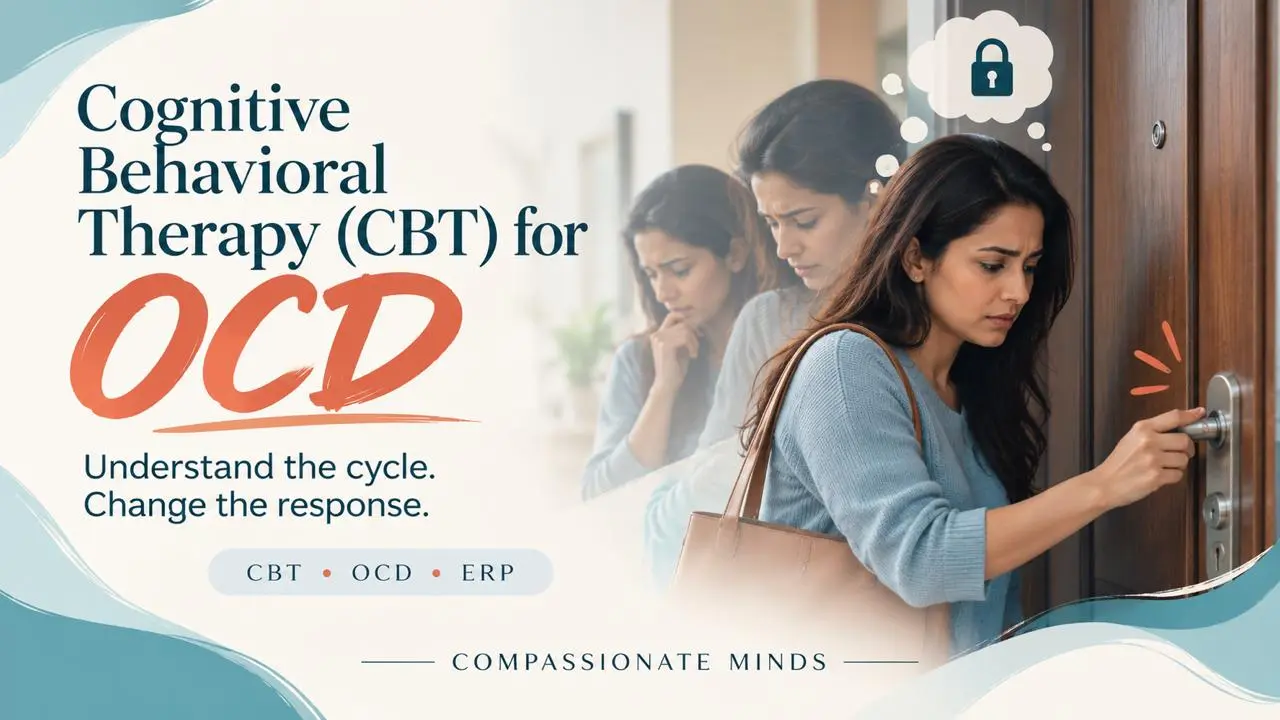
Cognitive Behavioral Therapy for OCD
Cognitive Behavioral Therapy for OCD: How It Works and Who It Helps
Cognitive behavioral therapy is one of the most reliable ways to break free from obsessive-compulsive disorder. It does not ask you to think positive or simply stop. It shows you how obsessions and compulsions feed each other, then guides you out of that loop through small, planned steps. The same approach also helps with panic attacks and anxiety, anxiety and stress, and depression, which often travel alongside OCD. Here we explain how it works, how long it takes, and when to seek help.
What Is Cognitive Behavioral Therapy?
Cognitive behavioral therapy, or CBT, is a structured, goal-focused talk therapy built on one idea: thoughts, feelings and behaviours are connected. How you interpret a situation shapes how you feel, and how you feel shapes what you do. When that chain turns unhelpful, anxiety, low mood and compulsive habits can take hold.
Unlike therapies that stay mostly in the past, CBT works on what keeps a problem going today. You and your therapist set clear goals, practise skills in session, and test them between sessions.
Understanding OCD and the Obsession-Compulsion Cycle
OCD is not about being neat or particular. OCD symptoms follow a two-part pattern. Obsessions are unwanted thoughts, images or doubts that spike distress, such as "Did I lock the door?" or "What if I harm someone by mistake?" Compulsions are the actions or mental acts used to get relief, such as washing, checking, counting, fixed prayers or asking for reassurance.
The relief never lasts. Each ritual teaches the brain that the doubt was a real threat, so the obsession returns stronger. In India this pattern is often brushed off as habit, shauk or extra carefulness, so many people wait years before finding proper OCD treatment.
Intrusive thoughts are normal. OCD begins when the mind treats them as dangerous, and a disturbing thought does not mean you want it or will act on it.
How Cognitive Behavioral Therapy Works for OCD
CBT for OCD usually moves through three overlapping stages.
Assessment and Psychoeducation
Your therapist maps your obsessions, compulsions, triggers and avoidance, including hidden mental rituals such as silent counting or mental reviewing. Seeing the cycle on paper often brings relief.
Cognitive Work
You learn to spot thinking traps common in OCD, such as inflated responsibility, the need for absolute certainty and treating a thought as if it were an action. You practise seeing a thought as a mental event rather than a warning.
Behavioural Work
This is where exposure and response prevention comes in, the part of treatment that does the heaviest lifting. Guidelines from the UK's NICE recommend CBT that includes exposure and response prevention as the psychological treatment of choice for OCD, which is why many clinicians call it the best therapy for OCD.
Exposure and Response Prevention: The Core of CBT for OCD
Exposure and response prevention, often called ERP therapy for OCD, has two parts. Exposure means deliberately meeting a trigger. Response prevention means choosing not to perform the ritual afterwards. You and your therapist build a fear ladder, ranking situations from mildly to severely distressing, and climb it one rung at a time.
A few examples show how exposure therapy for OCD works in practice:
- Contamination fears: touching a lift button or door handle, then delaying handwashing and eventually skipping the extra rounds.
- Checking: locking the door once, walking away, and resisting the urge to go back or take a photo as proof.
- Intrusive thoughts: writing out the feared thought without arguing with it or seeking reassurance.
An early rise in anxiety is expected, and it passes. With repeated practice, the distress after each exposure becomes shorter and weaker. Because ERP is one part of CBT, the question of CBT vs ERP for OCD is less a contest and more a matter of emphasis. ERP is the behavioural core, and the cognitive work supports it. A trained therapist should always pace exposures.
Cognitive Behavioral Therapy for Panic Attacks and Anxiety
OCD rarely travels alone. Many people with OCD also live with panic attacks and anxiety, and CBT is a first-line psychological treatment for both. A panic attack is a sudden surge of fear with a racing heart, breathlessness, dizziness or chest tightness, and it often feels like a medical emergency. Fear of the next attack leads to avoiding places, which keeps panic alive.
In CBT, you first learn how the panic cycle works: a body sensation, a catastrophic interpretation such as "I am having a heart attack", more fear, and stronger sensations. Then you test those predictions, practise calming and breathing skills, and gradually return to the situations you have been avoiding. The logic mirrors ERP. Facing the fear without escaping teaches the brain that it is safe. If you have chest pain or breathlessness for the first time, see a doctor first to rule out medical causes.
Cognitive Behavioral Therapy for Anxiety and Stress
Ongoing anxiety and stress feed OCD. Stress lowers your tolerance for uncertainty, and anxiety makes intrusive thoughts feel urgent. CBT gives you practical tools to interrupt that loop.
You learn to spot worry patterns, question "what if" predictions, solve problems step by step, and use structured relaxation. Many of our clients in Gurugram come with work pressure and family expectations, so we also work on boundaries and time management. A worry diary and a fixed worry time stop anxious thoughts taking over your day.
Cognitive Behavioral Therapy for Depression
Depression and OCD often occur together, because the exhaustion of rituals and the shame around intrusive thoughts wear down mood. Cognitive behavioral therapy is a well-established treatment for depression and is recommended in national guidelines. It works from two sides.
Cognitively, you learn to notice automatic negative thoughts such as "nothing will ever change" and test them. Behaviourally, you use activity scheduling, also called behavioural activation. This means planning small, doable activities that bring a sense of achievement or pleasure, even when motivation is low. As energy returns, thinking usually lightens too. If your mood is severe or you feel unsafe, speak to a doctor or psychiatrist straight away.
Is Cognitive Behavioral Therapy Effective?
Yes. CBT with ERP has the strongest evidence of any psychological treatment for OCD. A published review of clinical trials found that around 70 per cent of patients who stay with treatment see their symptoms reduce. Results depend on practice between sessions, a therapist trained in the method, and the severity of symptoms.
CBT is not a magic switch, but the goal is realistic: not to erase every intrusive thought or worry, but to stop them running your life.
CBT for OCD in Adults, Teens and Children
CBT for OCD in adults focuses on independent practice and on triggers at work, at home and in relationships. For teenagers, sessions also cover exam rituals and school pressure.
For CBT for OCD in children, parents become part of the team, learning to coach exposures calmly instead of joining rituals. Family accommodation, such as answering the same reassurance question again and again, feels kind but keeps OCD alive. Therapy helps families move from rescuing to supporting.
Can You Treat OCD Without Medication?
Many people do. For mild to moderate OCD, therapy alone is a valid first step, so OCD treatment without medication is often possible. In moderate to severe cases, or when anxiety and low mood make it hard to begin therapy, a psychiatrist may suggest medication alongside CBT. Our team includes Dr. Rajiv Sharma, a consultant psychiatrist, so you can be guided to the right mix. Never change medicines on your own.
How to Get the Most Out of Cognitive Behavioral Therapy
- Do the homework. Exposure only works when you repeat it between sessions.
- Cut down reassurance. Asking family or searching online for certainty gives short relief and strengthens doubt.
- Expect discomfort. A rise in anxiety during exposure is part of progress, not a sign that therapy is failing.
- Start small. Pick the lowest rung first and build confidence.
- Be honest about hidden rituals. Mental compulsions need treating too.
When to Seek Professional Help
Consider seeing an OCD psychologist if rituals take more than an hour a day, if you avoid places or people because of your fears, if work, studies or relationships are suffering, or if panic, stress or low mood are building alongside. Early help usually means shorter treatment, and OCD counselling works well online too.
Cognitive Behavioral Therapy at Compassionate Minds
At Compassionate Minds in Gurugram, we offer CBT-based therapy for OCD, panic attacks and anxiety, stress and depression, in our DLF Phase IV clinic and through secure online sessions across India. Sessions are confidential, non-judgmental and paced to you. To talk through your symptoms and next steps, book a free consultation or call +91-9151006808. This article is for education and does not replace a professional diagnosis.
FAQ
1. What is cognitive behavioral therapy and how does it help with OCD?
Cognitive behavioral therapy (CBT) is a structured talk therapy that links thoughts, feelings and behaviours. For OCD, it teaches you to see intrusive thoughts differently and uses exposure and response prevention to stop compulsions, so the obsession-compulsion cycle gradually weakens.
2. Is cognitive behavioral therapy effective for panic attacks and anxiety?
Yes. CBT is a first-line psychological treatment for panic attacks and anxiety. You learn how the panic cycle works, test frightening predictions, practise calming skills and slowly return to avoided situations. Most people notice benefits once they practise the skills between sessions.
3. Can cognitive behavioral therapy help with depression?
Yes. CBT for depression combines challenging automatic negative thoughts with behavioural activation, which means planning small, rewarding activities. It is recommended in national guidelines. If your mood is severe or you feel unsafe, speak to a doctor or psychiatrist straight away.
4. How long does cognitive behavioral therapy for OCD take?
Most plans are weekly. The UK's NHS mentions around 8 to 20 sessions for milder OCD, and at Compassionate Minds most clients improve within 12 to 20 sessions. Severe or long-standing OCD may need longer, and regular practice at home speeds progress.
5. Is ERP the same as cognitive behavioral therapy?
ERP, or exposure and response prevention, is the behavioural core of CBT for OCD, not a separate rival. You face a trigger and resist the ritual, while the cognitive work changes how you read intrusive thoughts. A trained therapist combines both.
 Mobile No. : +91-9151006808